Always Learning: Why Ongoing Training Matters at CleanSafe
Professional cleaning and restoration is about much more than having the right machine or knowing which product to use.
Different surfaces, materials and environments require different approaches. Products and equipment continue to develop, techniques improve, and sometimes the most important decision is knowing what not to do.
Experience plays a huge part in making those decisions. But at CleanSafe, we also believe experience should be supported by ongoing professional training and a willingness to keep learning.
That means investing not only in equipment, but in the knowledge needed to use it effectively, safely and appropriately.
Experience Is Important, but It Isn't Everything
There is no substitute for practical experience.
Working on different properties and surfaces teaches lessons that cannot always be learned in a classroom. It develops judgement, problem-solving skills and an understanding that two jobs which initially look similar may require very different approaches.
But experience can also be strengthened by formal training.
New products become available. Equipment develops. Manufacturers refine their systems and processes. Our understanding of different surfaces, treatments and restoration techniques continues to grow.
Ongoing training gives us an opportunity to challenge what we already know, learn different approaches and bring that knowledge back into the work we carry out every day.
Training Helps Us Make Better Decisions
One of the most valuable parts of specialist training is not simply learning how to carry out a particular process. It is understanding when that process is appropriate.
Before beginning specialist cleaning or restoration work, there can be a number of questions to consider.
What is the surface made from? What condition is it in? Has it previously been treated or sealed? Which products are compatible with it? What result is realistically achievable? Could a particular cleaning or restoration method cause unnecessary damage?
Good equipment is important, but it cannot make those decisions for you.
Training, combined with practical experience, helps us make better-informed choices about the products, equipment and processes we use.
Applying What We Learn on Real Jobs
For us, completing a training course isn't really the end of the process.
The value comes afterwards.
New knowledge has to be taken back onto real jobs, incorporated into our working methods and shared within the business. Sometimes that means introducing a new process. Sometimes it means refining an existing one. At other times, training simply gives us a better understanding of why a particular method works, or why another should be avoided.
It also gives us an opportunity to review the way we already work. If new knowledge, equipment or techniques can help us work more effectively, safely or consistently, we want to be willing to adapt.
That process of learning, applying and improving is something we intend to continue as CleanSafe grows.
Continuing Our Professional Stone Care Training
This week, CleanSafe's Paddy Meehan completed the two-day Faber Professional Stone Care Course in Dublin, continuing the ongoing professional development that underpins the way we work.
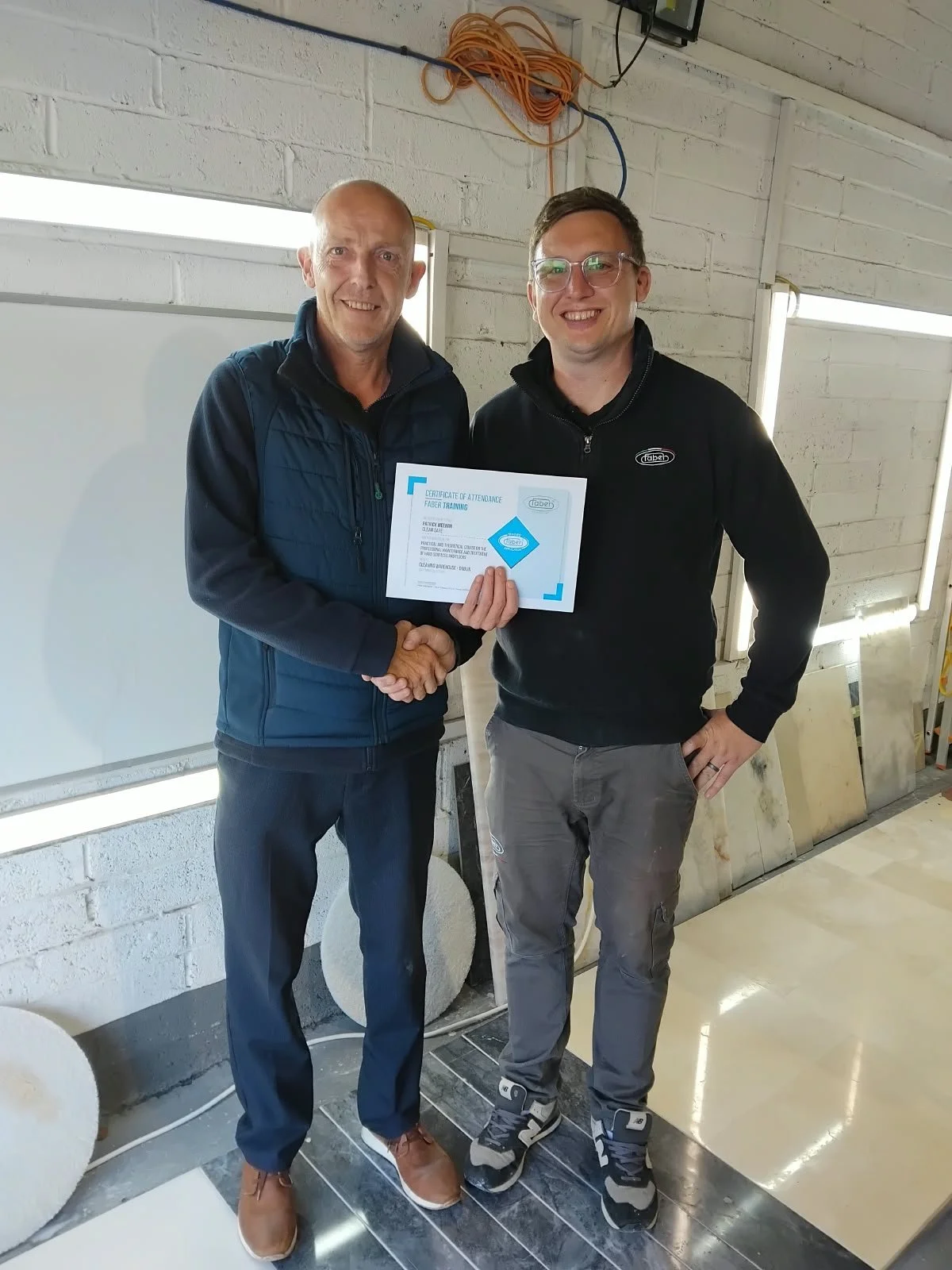
The specialist training covered the identification and treatment of natural stone and other hard surfaces, appropriate cleaning chemistry, stripping and sealing systems, stain diagnosis and problem solving, and grinding, honing and polishing techniques.
These are areas where understanding the surface is every bit as important as knowing how to operate the equipment. Natural stone and specialist hard floors can respond very differently to particular chemicals and processes, and an inappropriate treatment can sometimes cause problems rather than solve them.
The course provided an opportunity to develop existing knowledge further, learn directly about Faber's professional stone-care systems and bring additional techniques and understanding back into the work we carry out for CleanSafe customers.
For us, however, the certificate isn't the important part. What matters is taking that knowledge back onto real jobs and applying it where it can help us make better decisions and achieve better results.
Why Does Ongoing Training Matter to Our Customers?
Most customers understandably aren't interested in the technical detail behind every product, machine or process we use.
They simply want their property treated properly and the best realistic result achieved without unnecessary risk to the surface being cleaned or restored.
That is ultimately why continued learning matters.
Better knowledge helps us identify surfaces more accurately, choose appropriate methods, recognise potential problems before work begins and set realistic expectations about what can be achieved.
It also helps us work more consistently and make better decisions when a job doesn't respond exactly as expected.
Always Looking to Improve
We don't believe there is a point where you simply know everything there is to know about specialist cleaning and restoration.
There will always be another surface, another problem, another piece of equipment or another technique to learn about.
As CleanSafe continues to develop, we intend to keep investing in professional training, equipment and systems, while combining that knowledge with the practical experience gained from the work we carry out every day.
Because getting better at what we do isn't something we regard as a one-off exercise.
It's part of the job.